Showing posts with label about. Show all posts

FAQ about our reefs

  • Does Singapore have reefs?
  • Can an ordinary person see Singapore’s marine heritage?
  • What’s so special about Singapore’s reefs?
  • Why should we save our reefs?
  • Do Singaporeans care about our reefs and shores?
  • What are some of the challenges in conserving Singapore’s reefs and shores?
  • Is co-existence/a balanced approach to development and conservation possible?
  • How can one person make a difference for our reefs and shores?

1. Does Singapore have reefs?

Even though development has decimated Singapore reefs and only an estimated 10% of our marine natural heritage remains, the answer is an overwhelming YES! The litany of "uniquely Singaporean" statistics for our reefs includes:

More than 250 species of hard corals from 55 genera, which compare favourably with the more extensive reefs of the region
.A4 Poster: The Superb Sisters
More than 120 reef fish species from 30 families, and still counting.

11 out of the 23 seagrass species that can be found in the Indo-Pacific region.
Seagrass surprises
Dolphins and sea turtles are regularly spotted by boaters and divers. Dolphins are usually seen around the Sisters / St John's islands and also off Pulau Satumu (Raffles Lighthouse). Adult sea turtles are regularly seen around Pulau Hantu and Pulau Satumu, and newly hatched baby turtles have been encountered on a regular basis (about 4 sightings a year, at East Park Beach, Sentosa and West Coast Park Beach).

2. Can an ordinary person see Singapore’s marine heritage?

There are many options for the public to see the reefs of Singapore. For scuba divers, the Reef Xplore programme, run by the Hantu Bloggers, offers a guided tour of the underwater diversity of Pulau Hantu.

For non-scuba divers (and even scuba divers!), many volunteer groups run "No need to swim, no need to dive!" guided walks of our shores, including trips by the Naked Hermit Crabs (Sentosa and the Chek Jawa boardwalk), Blue Water Volunteers (Kusu Island) and the Raffles Museum of Biodiversity Research (Pulau Semakau).
A4 Poster: You CAN make a difference
Guided walks to other marine related habitats are also carried out at Chek Jawa on Pulau Ubin (where vast seagrass meadows still thrive), at the internationally famous Sungei Buloh Wetland Reserve (mangroves and shorebirds), together with the mangroves at Pasir Ris Park.

All the guided walks are family-friendly too! More details about regular reef and shores activites.

3. What’s so special about Singapore’s reefs?

In addition to the astounding biodiversity that exists on our reefs, they are also easy to get to! Where else in the world can a visitor quickly go from a high-level business meeting at a world class hotel, to visit a living reef in under half an hour? It only takes 15 minutes to reach the nearest reef by fast boat.
A4 Poster: Singapore has world-class reefs

4. Why should we save our reefs?


Worldwide, reefs provide a range of services. They are a food source for millions of people, and many reefs are also important tourist attractions, making them a critical source of livelihood and income for many coastal communities and industry players. They also provide vital ecosystems services - acting as a carbon sink and shore protections are just two such services.

In Singapore’s current effort to attract global clients of high net-worth, offering a full spectrum of natural attractions in close proximity to world class living conditions would be uniquely Singapore. A higher premium would accrue if Singapore develops urban living in a sustainable manner with sensitivity to existing ecosystems.

Singapore can excel in sustainable development, with the accent on sustainability, and also champion biodiversity conservation. Becoming not only a green, but also a blue city, and a more rounded global hub for environmental studies, research and practices.

In addition, the knowledge and expertise in all of this knowledge and databases can potentially generate revenue in environmentally friendly and sustainable developments overseas.

5. Do Singaporeans care about our reefs and shores?

Yes! About 3,500 volunteers work to provide guided walks, guided dives as well as conduct regular monitoring of seagrasses and reefs and to clean up and collect data on marine debris on our shores.

There is also a growing number of Singaporeans who blog and share photos and stories of their work for the shores. Latest blog entries about our reefs and shores.

Even larger numbers of Singaporeans, residents and visitors (to the tune of 100,000 annually) join these walks to view our shores and reefs. All regular guided tours on reefs are quickly booked within days of being offered. The wait-list for guided walks at Chek Jawa and Kusu Island remain long.
Labrador: A living classroom
Leading organizations have also formed the Singapore Reef and Marine Conservation Committee, which has for two decades, been engaging government to conserve our reefs, particularly in the formulation and implementation of Singapore’s Green Plans.

6. What are some of the challenges in conserving Singapore’s reefs and shores?

Coastal development vs conservation
Singapore has lost much of its natural coastal habitats to development. Ports and container terminals and offshore refineries have resulted in a distinctive, but urbanized skyline. Through mergers and expansions, the once over 60 offshore islands and patch reefs around Singapore have been reduced to about half in number, and many lagoons and public facilities are now scattered through out the existing ones. The coral reefs in Singapore have lost up to 80 to 90% of their live coral cover as a result of the direct and indirect effects of these developments.
A4 Poster: Threats to our shores - Coastal Development and Global Warming
Sedimentation
The most significant cause of reef degradation in Singapore is sedimentation, affecting the reefs by causing a slow but steady reduction in live coral cover and by reducing the lower depth limit of coral growth on reef slopes. Sedimentation studies in 1979 and 1994, show sedimentation rates ranging from 3-6mg/sq cm/day in 1979 to 5-45mg/sq cm/day in 1994 (the higher value obtained from localised areas close to reclamation projects). Surveys since 1986 indicated that live coral cover decreased by up to 80% on some reefs, although other reefs registered less impact. The reduction in sunlight penetration has reduced the lower depth limit of coral growth. In the 1980s, coral growth extended to 10m down the reef slopes. Today, growth is restricted to 6m although some coral species still occur at the 8m depth. Visibility has reduced from 10m in the 1960s to 2m or less today. As a consequence, coral growth is restricted to the shallow depths, as opposed to reefs in clear waters, where coral may be found at depths of 20m and more.

Careless treatment of our reefs and shores
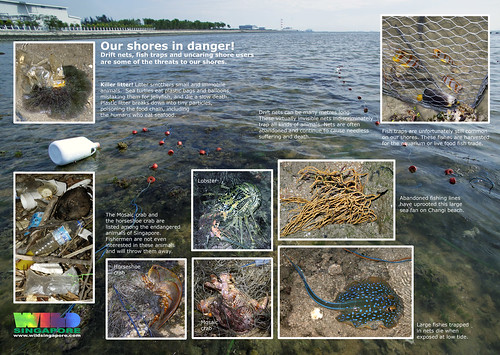
Other activities that also have an impact on the reefs include recreational and tourist-related use. Negligent or inexperienced reef-users without proper buoyancy control, can leave a trail of broken corals. Improperly dropped anchors can uproot large coral heads, and indiscriminate collection of marine life on our shores depletes already strained plant and animal stocks, and destructive fishing practices can leave behind abandoned drift nets and fish cages.
7. Is co-existence/a balanced approach to development and conservation possible?

The Semakau Landfill, Singapore’s only existing landfill, was developed and operated in such a way that half of the original Pulau Semakau remained relatively undisturbed. The coastal habitats on the western side of the island are still intact, and nature walks there are an eye-opening discovery of wild mangroves, vast seagrass meadows and amazing coral reefs!
A4 Poster: Pulau Semakau Seagrass Meadows
This know-how will be much sought after as other countries seek to manage the disposal of solid wastes and develop with minimal impact to their large natural reefs and coastal habitats, for tourism or other purposes. Sustainable coastal development can be exported in the same way Singapore has exported the technologies, policies and processes, for dealing with limited water and other natural resources. Habitat restoration and enhancement successes, will also be sought after.
A4 Poster: Cyrene Reef
Every development near the shore should be seen as an opportunity for Singapore to prove that it has the know-how to develop and operate first-world facilities without wiping out natural habitats.

8. How can one person make a difference for our reefs and shores?

We highly encourage interested individuals to simply "Explore, Express and Act".

Explore our shores
Visit our shores and reefs. See them for yourself! Join the many activities for our reefs in 2008. Links to the various activities can be found on our Singapore Celebrates our Reefs blog (http://iyor08singapore.blogspot.com).

Express for our shores
Share your experiences, your hopes and your knowledge about our reefs. Tell your family, your friends and your colleagues! And tell us about it, too!! We'd love to hear from you! Or, if you have your own blog or website, we can add it to the Singapore Celebrates our Reefs blog (http://iyor08singapore.blogspot.com).

Act for our shores
Be a volunteer! If you have a passion for nature, make the time to help out with local conservation groups. Most have activities to suit any contribution of skill, time and energy. Every contribution, large and small, short-term and long-term, can make a big difference.

Here's MORE ways to make a difference for our reefs.

Singapore IYOR efforts

Who are involved in organising IYOR efforts and what are some of the focus areas and activities?

IYOR 08 Singapore Framework

IYOR 08 Singapore has been initiated by a diverse group of individuals and organizations, active in marine conservation, that come together in recent years as the Marine Round Table. Two consultative sessions were held, one in 2006 and the other in 2007. This Marine Round Table has formed the IYOR 08 Singapore Organising Committee. It is an open and inclusive Committee, serving only to initiate and co-ordinate activities, and will welcome any like-minded volunteer who wishes to join in.

The advisors, officers and members of the IYOR 08 Singapore Organising Committee are:

I) Hon Advisors:
Prof Tommy Koh, Ambassador at large
Prof Chou Loke Ming, Professor, the National University of Singapore
Dr Shawn Lum, President, Nature Society (Singapore)
Dr Geh Min, former President, Nature Society (Singapore), Former NMP
Dr Isabelle Louis, Director, Asia Pacific Programme, WWF International
Mr Edwin Khew, NMP, CEO & MD, IUT Global and Chairman, SEAS
Mr Balakrishnan, Commodore, Republic of Singapore Yacht Club
Mr Bob Ashman, Commodore, Changi Sailing Club
Mr Arthur Tay, Chairman, ONE°15 Marina Club
Ms Wang Look Fung, Keppel Corp Ltd
Ms Abigail Alling, President, Planetary Coral Reef Foundation, USA

II) Officers:
Mr Francis Lee, Chairman
Mr Leong Kwok Peng, Dy Chairman
Mr Jeffrey Low, Vice Chairman
Mr Farid Hamid, Vice Chairman
Ms Kelly Ong, Vice Chairman
Ms Ria Tan, Hon Secretary
Ms Kelly Ong, Dy Hon Secretary

III) Focus Clusters:
Reef Database Cluster
Mr Jeffrey Low, Chairman

Blue Plan Cluster
Mr Farid Hamid, Chairman

Awareness & Outreach Cluster
Ms Kelly Ong, Chairman

IYOR 08 Singapore focuses its work in three main clusters, namely:

(1) Reef Database Cluster
Chaired by Jeffrey Low (NParks)
The goal for this Cluster is to collate and review the reef databases already available, find out which are open and which are locked. For locked databases, to explore how these could be opened if only for IYOR 2008 and consolidation, to form a central national database. The Cluster will also consider where additional data is needed, avoid duplication in data collection, and look into updating data, organise training and conduct fresh surveys.

Members include the Raffles Marina, the Republic of Singapore Yacht Club (RSYC), the Changi Sailing Club, ONE°15 Marina Club, Keppel Marina, Singapore Underwater Federation (SUF), NParks, Blue Water Volunteers and other constituent members of the Singapore Reef and Marine Conservation Committee. The RSYC will take the lead on the fresh field surveys needed.

(2) Blue Plan Cluster
Chaired by Farid Hamid (Ithaca)
The goal for this Cluster is to review the previous prototype Blue Plan submitted. Utilizing information gathered from the efforts of the Reef Database Cluster, the Cluster will take the lead in formulating and drafting a new comprehensive Blue Plan for Singapore, as a vital contribution to the conservation of our coral reefs and to actualize the vision of together, making Singapore into a coral paradise over the next 10 years. This new proposal should reflect good master planning, balance development with sustainability and promote the proper stewardship of the reefs in Singapore.

Consideration will be taken of the carbon sequestering aspects of large bodies of waters in Singapore seas, mangroves, reefs and other shore ecosystems. Surveys on how ordinary people value the shores can be done, as well as consultations with the public, reaching out to target groups with materials specific to these groups, for example, fishermen, boaters and divers. Following such efforts, talk-walks can then be offered to decision-makers and captains of industry. These events will have to be managed differently from field trips. It was suggested that these trips should be on a private basis, so that decision-makers and captains of industry can be more relaxed, rather than as publicity trips with the press.

The Blue Plan will then be the theme to be considered at the next Marine Roundtable 3, in 2008 and publicity of the Blue Plan would be considered as a 'finale' event for IYOR 08 Singapore.

Members include Chua Sek Chuan, Leong Kwok Peng and Nigel Kaw.

(3) Awareness and Outreach Cluster
Chaired by Kelly Ong (Underwater World S)
The goal of this Cluster is to inform and instill interest in our reefs, to dispel the notion that Singapore does not have any reefs left, and to raise awareness on what we can do to protect coral reefs.

Other than the production and free distribution of literature and collaterals to interested individuals, schools and organizations, a wide range of activities will be held in celebration of IYOR which will include public talks, roving exhibitions, dives at our reefs and intertidal walks on our shores.

The “Singapore celebrates our reefs” blog http://iyor08singapore.blogspot.com/ was set up to publicize these efforts, with feature articles about our shores and issues in marine conservation. A flickr IYOR group was set up to share high resolution photos of our shores. It now has 38 members and nearly 2,000 high resolution photos. http://www.flickr.com/groups/619241@N24/

Members include Underwater World Singapore, ECO-Singapore, WildSingapore, Blue Water Volunteers, Hantu Bloggers, TeamSeagrass, Naked Hermit Crabs, Raffles Museum of Singapore, Nature Society Singapore, and many more.

IYOR 08 Singapore Organising Committee members (in alphabetical order)
Aaron Yeo (ECO-Singapore)
Belmont Lay (NUS/Roots & Shoots)
Benny Ng (Raffles Marina)
Commodore Balakrishnan (Republic of Singapore Yacht Club)
Debby Ng (Hantu Blog)
Edzra Iskandar (Ministry of Education/Nature Society Singapore)
Farid Hamid (Ithaca)
Francis Lee
Ivan Choong (Nature Society Singapore/Flying Manta Project)
Jeff Mahon (Underwater World Singapore)
Jeffery Low (NParks)
Jezamine Lee (Haw Par Corpn)
Juward Ho (Underwater World Singapore)
Kelly Ong (Underwater World Singapore)
Kua Kay Yaw (Singapore Underwater Federation)
Leong Kwok Peng (Nature Society Singapore)
Neo Wee Sim (Republic of Singapore Yacht Club)
November Tan (Naked Hermit Crabs)
Ria Tan (wildsingapore)
Roy Yeo (Underwater World Singapore)
Stephen Beng (Singapore Underwater Federation)
Stephen Lau (Nature Society Singapore)
Tan Hang Chong (Nature Society Singapore)
Vivian Mamawag (World Wide Fund for Nature, WWF)
Wilson Ang (ECO-Singapore)
Yves De Leeneer (Planetary Coral Reef Foundation)

IYOR 08 Singapore Calendar of Events

To celebrate Singapore's marine life, the members of IYOR 08 Singapore have consolidated their efforts and programmes to present a year-long calendar of activities. This wide range of activities will cater to almost every member of the public, including monthly dives of our reefs, walks on our shores (for those do not want to swim or dive), talks, outings and excursions, of various kinds.

The dives will be conducted in our southern islands, primarily at Pulau Hantu, while walks will be organised at diverse locations - Chek Jawa, Pulau Semakau, Kusu Island, Sentosa, Cyrene Reef, Sungei Buloh and Pasir Ris. There are also special programmes such as the Marine Fish tours and PrawnWatch at Sungei Buloh.

The public are also welcome to join in the monitoring of our marine habitats, run by TeamSeagrass (monitoring the seagrass meadows) and Reef Friends (monitoring the coral reefs of Singapore).

Schools and volunteer groups will be welcome to not only take part, but create projects to supplement these activities and cater to the needs of their students and constituencies.

Major celebrations of IYOR include outreach activities at the Asian Dive Expo (ADEX) in April, and International Coastal Cleanup Singapore in September. There will also be a roving IYOR road show comprising of exhibits about Singapore's living reefs, that will be hosted at schools, community clubs, recreational clubs, and various locations throughout the year. Talks are also being offered to the public, about Singapore's shores and marine issues.

List of these activities.

International Year of the Reefs 2008

We CLEARLY have reefs! The reefs off Sisters Islands are visible on a clear water day2008 is the International Year of the Reef (IYOR), celebrated worldwide to raise awareness about the value and importance of coral reefs and threats to their sustainability, and to motivate people to take action to protect them.

IYOR was first declared 10 years ago in 1997 and a decade later, IYOR is back! This time, Singapore will be celebrating along with 50 countries around the world to celebrate our reefs! In fact, all the reef-loving groups in Singapore have come together to dedicate 12 months of round the year events to celebrate the amazing coral reefs we have in Singapore! All are welcome to participate in these events and to submit to the IYOR Singapore executive committee any related projects that they would like to add on the IYOR calendar of events! More details can be found in the Events section.

Stunning reefs are still found especially on undisturbed shores such as Raffles Lighthouse

Background information

The first IYOR campaign in 1997 was initiated in response to the increasing threats and loss of coral reefs and associated ecosystems, like mangroves and sea grasses. IYOR 97 was a global effort to increase awareness and understanding of coral reefs, and support conservation, research and management efforts.

IYOR 97 proved to be very successful, with over 225 organizations in 50 countries and territories participating, over 700 articles in papers and magazines generated, hundreds of scientific surveys undertaken, and catalyzed conservation and policy initiatives, as well as numerous local and global organizations dedicated to coral reef conservation.

Recognizing that ten years after IYOR 97 there continues to be an urgent need to increase awareness and understanding of coral reefs, and to further conserve and manage valuable coral reef and associated ecosystems, the International Coral Reef Initiative designated 2008 as the International Year of the Reef (IYOR 2008).

In the year 2008, IYOR aims to:
  • Strengthen awareness about the ecological, economic, social and cultural value of coral reefs and associated ecosystems
  • Improve understanding of the critical threats to coral reefs and generate both practical and innovative solutions to reduce these threats
  • Generate urgent action at all levels to develop and implement effective management strategies for conservation and sustainable use of these ecosystems

Participating Organisations

The Naked Hermit Crabs are a motley bunch of volunteers who share the shores with the public - and have a great time doing it too!In the spirit of the reefs, IYOR 2008 Singapore has brought together all groups, organizations and individuals concerned with our shores and coral reefs. In fact, if you have a project or know somebody who is working on a reef-related project, do get in touch with us.

IYOR 2008 Singapore
Participating Organisations

(In Alphabetical Order)

Blue Water Volunteers
http://www.bluewatervolunteers.org/
A volunteer-based, marine conservation NGO that seeks to complement research activities and increase awareness of local marine habitats, such as coral reefs. We strive to achieve our aims for conservation, awareness and education through four main programmes: ReefFriends, ReefWalk, ReefTalk and ReefExhibits.

Changi Sailing Club
http://www.csc.org.sg/

Cicada Tree Eco-place
Cicada Tree Eco-Place is a new non-profit non-government organisation which promotes nature, culture and eco-living through environmental education. Founded in 2007 by educators and environmentalists, Cicada Tree Eco-place will begin programs for kids (5 to 10 years old) and schools from August 2008 onwards. Called mad lessons for wildlife, these lessons will focus on animals, plants and ecology and how each of us can make a difference by lessening our carbon footprint through simple daily eco-actions.

ECO Singapore
http://www.eco-singapore.org/
ECO Singapore is a non-profit, non-government organization. ECO aims to establish a voluntary environmental movement, thereby creating opportunities for active involvement by Singaporean youths, instilling a sense of commitment and awareness of environmental issues and global hazards. By providing youths a holistic approach towards environmental issues, ECO Singapore’s mission is to encourage youths to take initiative and choose to live environmentally sustainable lifestyles.

Flying Manta Project
http://www.flyingmantaproject.org/

Green Drinks
http://www.greendrinks.sg/
Green Drinks is platform for environmentalists to discuss sustainable living and its related issues in an informal networking session over drinks. Already active in more than 230 cities, Singapore is the latest city to join the movement!

The Hantu Blog
http://www.pulauhantu.org/
The Hantu Blog is a non-profit, environmental awareness initiative for Pulau Hantu, an island recognised by most divers as Singapore’s most popular Southern Island, known for its sheltered and biologically diverse reefs. It is now described as a new-age NGO that utilises modern, free-media, to enhance the awareness of Singapore’s coastal and marine habitat.

International Coastal Cleanup Singapore
http://coastalcleanup.wordpress.com/
http://coastalcleanup.nus.edu.sg/
The International Coastal Cleanup, Singapore (ICCS) is coordinated by volunteers of the Raffles Museum of Biodiversity Research of the National University of Singapore. The programme is strongly supported by Sungei Buloh Wetlands Reserve, Waterways Watch Society and numerous local and international schools, institutions and organisations that have battled the curse of marine litter for almost two decades. The International Coastal Cleanup (ICC) is an annual event conducted in 70-100 countries, coordinated by the US-based agency, The Ocean Conservancy, a non-profit organisation. It aims to remove and collect data on the debris from the shorelines, waterways and beaches of the world's lakes, rivers and oceans. This information serves to educate the public on marine debris issues and to encourage positive change by submissions to governmental and international organisations that will reduce debris in waterways and enhance aquatic environments.

Ithaca (Singapore) Pte Ltd
http://www.ithaca.sg/
Ithaca specializes in experiential learning methodologies for schools, community & grassroots leaders, government agencies, not for profit organizations & corporate organizations, in the field of diversity education (inter-ethnic, inter-faith education), service learning (internationally and within Singapore), leadership development, environmental education, team development, adventure education.

IUT Global Pte Ltd
http://www.iutglobal.com
IUT Global Pte Ltd is a Singapore-based niche environmental waste management company providing a comprehensive and scalable suite of waste treatment technologies & management solutions for the Asia-Pacific region. Founded by a management team with comprehensive experience in the environmental industry and extensive regional public & private sector networks to assure successful project implementation and operational support.

Keppel Group
http://www.kepcorp.com/
As the Keppel Group continues to grow its businesses, it remains committed to the preservation and enhancement of the environment.

Keppel Group, together with its partners, National Parks Board, National University of Singapore and National Environment Agency, launched the first coral nursery in Singapore at a site off Pulau Semakau on 30 July 2007.

Keppel is the first private organisation to recognise the importance of a coral nursery in Singapore by contributing $250,000 over two years to support the marine conservation project. Beyond funding Keppel is also committing its expertise, resources and volunteers to support this project.

Committed to protecting the environment and improving environmental conditions, Marina at Keppel Bay, which is located on Keppel Island, is the first and only Marina in Asia to be awarded a “Clean Marina” certification by the Marina Industries Association of Australia (MIAA).

In our subsidiaries overseas, Keppel works with local and government agencies to spread the green message. In Brazil, Keppel worked with environmental consultants to minimise the impact of the dredging of Jacuecanga Bay. In Philippines, Keppel worked with the Philippine Coast Guards to clean up approximately 5km of the shoreline near the shipyard as well as sending divers to take part in an underwater clean-up of Lapu-Lapu beaches.

Keppel views the protection of the environment integral to our pursuit of sustainable growth.


Naked Hermit Crabs
http://nakedhermitcrabs.blogspot.com
The Naked Hermit Crabs are a motley bunch of volunteer guides who have come together to share our other shores through public walks. Especially those shores which are in danger.

National Parks Board
http://www.nparks.gov.sg
As Singapore's scientific authority on nature conservation, NParks monitors and coordinates measures to ensure the health of designated nature areas.

Nature's Niche
http://www.naturesniche.com/
Seeing, Knowing, Loving. Nature's Niche specialises in nature books and nature-related merchandise.

Nature Society (Singapore)
http://www.nss.org.sg/
NSS is a non-government, non-profit organisation dedicated to the appreciation, conservation, study and enjoyment of the natural heritage in Singapore, Malaysia and the surrounding region.

NIE Green Club
http://niegreenclub.blogspot.com/
A group of nature enthusiasts from the National Institute of Education whom have gathered to discover more about nature together.

Planetary Coral Reef Foundation
http://www.pcrf.org/
PCRF's vision is to stop the destruction of the world's coral reefs by 2020 and restore their beauty, health and abundance within this century.

Raffles Marina
http://www.rafflesmarina.com.sg/

Raffles Museum of Biodiversity Research
http://rmbr.nus.edu.sg
and the Toddycats! Volunteers of the RMBR
http://toddycats.wordpress.com/
Toddycats! is meant to expose, develop, enthuse and apply individuals to programmes in conservation, education and research. The programme was originally meant to provide capacity building amongst undergraduates in NUS, and to provide them with an immediate means to contribute meaningfully towards the greater good of Singapore. The programme is now open to anyone who can fit our schedule, in the recognition that all you really need is enthusiasm and commitment!

Republic of Singapore Yacht Club
http://www.rsyc.org.sg/
RSYC is Singapore’s oldest club and leading Private Members’ yacht club. With comprehensive facilities including rooms, fine dining & swimming pool, it caters to a full range of sailing, powerboating and other sea sports. RSYC has been a pioneer of marine conservation since the ‘80s and continues to support initiatives to protect our reefs.

Roots and Shoots (Singapore)
http://www.rootsandshoots.org/
The Roots & Shoots program is about making positive change happen—for our communities, for animals and for the environment. And it all starts with you! With tens of thousands of young people in almost 100 countries, the Roots & Shoots network branches out across the globe, connecting youth of all ages who share a common desire to help make our world a better place.

Simply Green
http://www.simplygreen.com.sg/
Simplygreen will encourage the participation of activities that will heighten the consciousness of all humans towards thinking and living green. And the appreciation of nature can be an exhilarating experience.

Singapore Environment Council
http://www.sec.org.sg/
The mission of the Singapore Environmental Council is to educate, inspire and assist individuals, business organisations and environmental groups to care for and protect the environment.

Singapore Underwater Federation
http://www.suf.org.sg/
The vision of the SUF are a sub-aquatic sporting lifestyle for Singapore. A professional Singaporean dive industry with world-class standards. An environmentally aware Singapore which treasures our natural heritage.

Sport Fishing Association of Singapore
http://www.sfas.net/
The SFAS practice catch and release and among the rules are that anglers must demonstrate proper conduct and practice good fishing ethics and etiquette, and anglers are to use artificial lures or flies for sport fishing and not to use any organic baits (dead or alive) in all fishing activities.

Star Trackers
http://startrackers.blogspot.com/
Sharing knowledge and creating public awareness regarding the knobbly seastar populations in Singapore.

Sustainable Energy Association of Singapore (SEAS)
http://www.seas.org.sg
Launched on 12th July 2006, SEAS represents the interests and provides a common platform for companies in renewable energy, energy efficiency, carbon trading, clean development mechanism projects and the financial institutions to meet, discuss, collaborate and undertake viable projects together. The Association also extends its focus to include capacity building, technology strengthening and market intelligence sourcing to assist its members in achieving sustainable growth.

Currently, the council of SEAS is made up of ten members, chaired by Mr Edwin Khew, CEO & MD IUT Global, a biomass to Energy Company. The patron of SEAS is Dr Amy Khor, Senior Parliamentary Secretary of the Ministry of Environment and Water Resources and Chairman of the National Climate Change Committee (N3C). In addition, acting as advisors to the council are government agencies that include MEWR, NEA, IE Singapore, EDB, SPRING and MTI.

SEAS aims to facilitate the business of its member companies, and thus developing Singapore as the regional centre for the promotion of energy efficiency technologies and services, showcasing of renewable energy technologies, carbon asset management and trading as well as clean energy finance.


TeamSeagrass
http://teamseagrass.blogspot.com/
As part of International Seagrass-Watch, we are a team of volunteers from all walks of life who regularly monitor the seagrasses on Singapore's shores, gathering data that will help us better understand and manage our seagrass meadows.

Underwater World Singapore
http://www.underwaterworld.com.sg/
Underwater World Singapore is a wholly owned subsidiary of Haw Par Corporation. Our mission goes beyond making our guests aware of the fascinating marine life in the oceans. Over the years, UWS has sought to raise public awareness on marine conservation issues via our exhibits, interpretive panels, enriching educational programs, as well as various breeding, rehabilitation, research and conservation projects. We deem it an important responsibility of ours, as an oceanarium, to inspire our visitors to do their part to conserve the fragile marine environment. Our newly launched conservation slogan: Blue Mission - Inspire, Educate, Conserve, represents aptly our vision and the work that we strive to do.

wildfilms
http://wildfilms.blogspot.com/
Volunteers desperately documenting Singapore's fragile shores before they disappear. Shoot first, ask questions later! No budget, no time and often no clue.

wildsingapore
http://www.wildsingapore.com
A one-stop location for Singaporeans who want to learn about our wild places; and do more for them. One person CAN make a difference! Simply explore, express and ACT!

World Wide Fund for Nature (WWF)
http://www.panda.org/
WWF is one of the world’s largest and most experienced independent conservation organizations, with a global network active in more than 100 countries. WWF’s goal is to stop the degradation of the planet's natural environment and to build a future in which humans live in harmony with nature. More information is available on www.panda.org. In Asia Pacific, WWF envisions a regional conservation economy where economic growth supports the preservation of natural resources. By forging partnerships in Singapore, and working together with the local government, Singapore-based companies, other NGOs and the local community, WWF in Singapore aims to deliver positive and lasting change in the Asia Pacific region.